
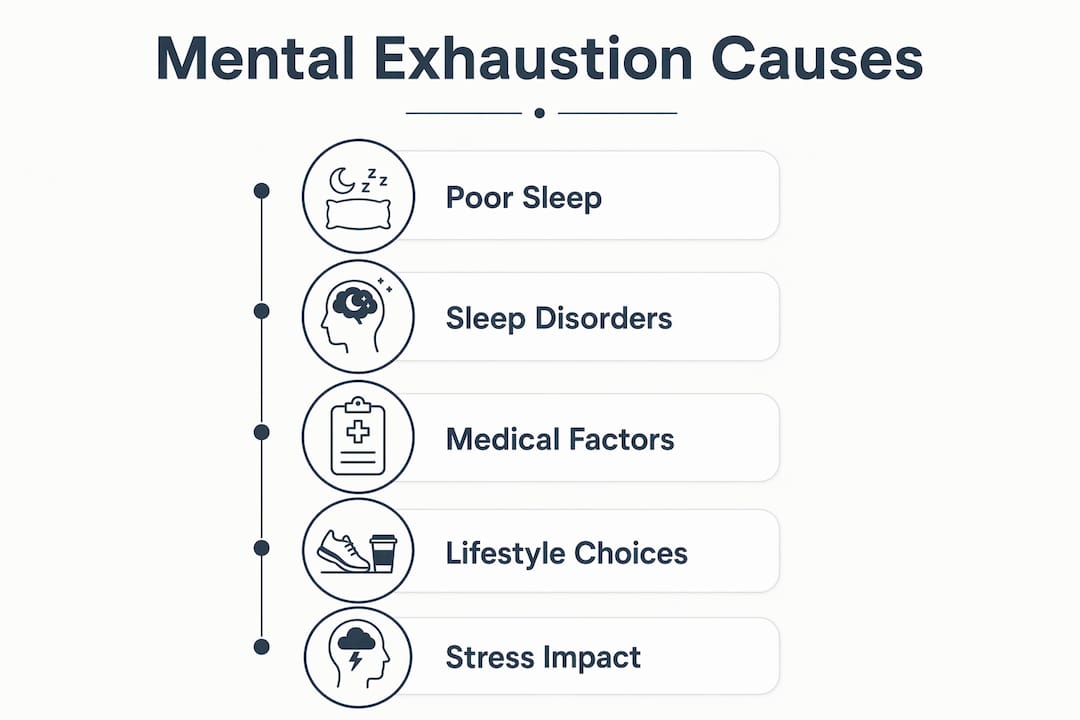
Waking up tired despite a full night’s sleep usually comes down to sleep quality, not sleep duration. You can log 7–9 hours and still feel mentally drained if your sleep is fragmented, shallow, or disrupted by an underlying condition. The core issue is that your brain never fully enters the deep, restorative stages it needs to clear metabolic waste and reset cognitive function. Here are the most common reasons this happens:
- Sleep disorders like sleep apnea fragment sleep through repeated micro-awakenings
- Chronic stress and anxiety keep the nervous system in a state of hyperarousal
- Poor sleep environment (noise, light, temperature) prevents deep slow-wave sleep
- Circadian rhythm disruption from shift work, jet lag, or social jetlag misaligns your body clock
- Caffeine, alcohol, and certain medications interfere with sleep architecture
- Underlying medical conditions such as anemia or thyroid disorders reduce sleep quality
- Mental fatigue from sustained cognitive load that passive rest alone cannot resolve
Understanding these causes is the first step toward actually fixing them.
What sleep disorders cause you to wake up mentally exhausted?
Sleep disorders are among the most underdiagnosed reasons people feel mentally drained after sleep. You may spend eight hours in bed and still miss out on the slow-wave and REM stages your brain depends on for restoration. The problem is not how long you sleep. It is how many times your sleep is interrupted.
- Obstructive sleep apnea causes the airway to collapse repeatedly during the night, triggering brief arousals that fragment sleep architecture without you ever fully waking. Many people with sleep apnea have no idea they have it.
- Restless legs syndrome produces uncomfortable sensations in the legs that worsen at night, making it physically difficult to stay in deep sleep.
- Paradoxical insomnia involves a mismatch between how rested you actually are and how rested you feel. Your brain registers sleep as wakefulness, creating persistent sleep anxiety and mental exhaustion even when objective sleep time is adequate.
- Micro-awakenings from any cause, including noise or light, pull you out of deep non-REM sleep repeatedly. Each interruption resets the sleep cycle, reducing total restorative sleep time.
If you consistently wake up unrefreshed and cannot identify a clear lifestyle cause, a sleep study is worth discussing with your doctor.
How do medical conditions and lifestyle factors drain your mental energy?
Several medical and behavioral factors degrade sleep quality in ways that are easy to overlook. They do not always prevent you from falling asleep. They just prevent your sleep from being restorative.
- Anemia and thyroid disorders reduce the body’s ability to regulate energy and hormones during sleep, leaving you cognitively depleted by morning.
- Anxiety and chronic stress trigger a state researchers describe as “wired but tired,” where elevated cortisol in the evening delays the hormonal sequence needed for deep sleep and impairs the brain’s glymphatic waste-clearance system.
- Caffeine consumed in the afternoon or evening suppresses adenosine, the chemical signal that builds sleep pressure, pushing back your natural sleep onset and shortening deep sleep.
- Alcohol may help you fall asleep faster but suppresses REM sleep in the second half of the night, leaving you cognitively foggy in the morning.
- Shift work and jet lag misalign your circadian rhythm with your actual sleep schedule. Social jetlag, which is the gap between your sleep timing on workdays versus days off, produces a similar effect to frequent time-zone travel and raises cardiometabolic risk over time.
- Certain medications, including some antihistamines, beta-blockers, and antidepressants, alter sleep architecture and can reduce slow-wave sleep depth.
Pro Tip: If you rely on caffeine to get through the afternoon, try cutting it off by 1:00 PM for two weeks and track whether your morning mental clarity improves. The half-life of caffeine is roughly 5–6 hours, meaning a 3:00 PM coffee still has a measurable effect at 9:00 PM.
Does your sleep environment affect how mentally rested you feel?
Your bedroom environment directly shapes the quality of sleep you get, not just whether you fall asleep. Environmental disruptions like noise, excessive light, and temperature extremes cause micro-awakenings and prevent the deep slow-wave sleep stages where the brain does most of its recovery work. The frustrating part is that these arousals are often too brief to remember, so you wake up confused about why you feel so depleted.
- Noise triggers the brain’s threat-detection system even during sleep, pulling you into lighter sleep stages without full waking.
- Light exposure suppresses melatonin production. Even low-level light from a phone screen or streetlight through thin curtains can delay sleep onset and reduce sleep depth.
- Room temperature above 67–70°F interferes with the body’s natural core temperature drop that initiates deep sleep.
- Evening screen use exposes your eyes to blue-spectrum light that signals daytime to the brain, delaying your circadian clock by up to two hours.
- Lack of psychological wind-down cues keeps the brain in an alert state. Without clear behavioral signals that the day is over, the brain’s salience networks stay active, preventing full disengagement into restorative sleep.
Building a consistent evening relaxation routine addresses several of these factors at once. Dimming lights, lowering the thermostat, and stepping away from screens an hour before bed give your brain the environmental cues it needs to shift into recovery mode.
When should you see a doctor about persistent mental exhaustion after sleep?
Self-care strategies help most people, but some patterns of exhaustion signal a condition that needs professional evaluation. Knowing when to seek help can prevent months of unnecessary suffering.
- Excessive daytime sleepiness that persists despite consistent sleep schedules and good sleep hygiene warrants a medical assessment.
- Loud snoring, gasping, or witnessed breathing pauses during sleep are strong indicators of obstructive sleep apnea, which requires a sleep study for diagnosis.
- Mood changes, irritability, or difficulty concentrating that have lasted more than two weeks alongside poor sleep may indicate a mood disorder or anxiety condition that is disrupting sleep from the inside out.
- Chronic sleep fragmentation that does not improve with environmental changes suggests an underlying physiological cause.
- Symptoms consistent with Brain Fatigue Syndrome, including disproportionately long recovery times after mental tasks, memory problems, and sensitivity to light and noise, may indicate neuroinflammatory involvement that requires specialist evaluation.
A better sleep assessment can help you identify whether your symptoms point toward a sleep disorder, a medical condition, or a behavioral pattern. When in doubt, a primary care physician is the right starting point. They can refer you to a sleep specialist or order relevant bloodwork to rule out conditions like anemia or thyroid dysfunction.
What is actually happening in your brain when you feel mentally exhausted?

Mental fatigue is a distinct psychobiological state, separate from physical tiredness and separate from sleepiness. It impairs concentration, motivation, and emotional regulation, and it requires a different kind of recovery than simply lying down. Research describes mental fatigue as a state that manifests as slower reaction times, increased error rates, and reduced willingness to engage in tasks, even when the body feels physically rested.

The neural mechanism involves over-activation of the frontal cortex. When the brain is under sustained cognitive load, glutamate accumulates in synaptic spaces faster than it can be cleared. This buildup impairs synaptic transmission and forces larger, less efficient brain networks to activate, consuming more energy for the same cognitive output. Sleep is supposed to clear this backlog through the glymphatic system, but disrupted slow-wave sleep inhibits glymphatic clearance, meaning the metabolic waste from a full day of thinking stays in your brain overnight.
Stress compounds this directly. Elevated cortisol in the evening skews the hormonal sequence that initiates restorative sleep, preserving alertness circuits that should be offline. The brain’s salience networks, which are responsible for threat detection, remain partially active during sleep, reducing the depth of slow-wave stages where the most critical neural repair occurs.
In more severe cases, Brain Fatigue Syndrome describes a state where neuroinflammation impairs astrocyte function, reducing glutamate uptake and synaptic efficiency. People with this condition experience disproportionately long recovery times after mental tasks, and sleep alone does not resolve the fatigue. This can occur after traumatic brain injury, prolonged stress, autoimmune conditions, or systemic inflammation.
A 2025 meta-analysis found that improving sleep quality produced meaningful reductions in both depression and anxiety scores, with effect sizes that exceeded those from simply increasing total sleep time. Quality of sleep, not quantity, drives mental restoration.
Pro Tip: Take short naps of under 20 minutes and fully disengage from screens during rest breaks. Naps under 20 minutes allow glutamate clearance without triggering sleep inertia, making them more effective for mental recovery than longer naps or passive phone scrolling.
Learning to unwind after a stressful day with deliberate, screen-free downtime is one of the most direct ways to lower cortisol before bed and give your brain the conditions it needs to actually restore overnight.
Key Takeaways
Sleep quality drives mental restoration more than sleep duration alone, and addressing the specific cause of poor sleep quality is what produces lasting improvement.
| Point | Details |
|---|---|
| Quality over quantity | Sleeping the recommended amount of hours does not guarantee restoration if sleep is fragmented or shallow. |
| Sleep disorders are often hidden | Sleep apnea and restless legs syndrome disrupt deep sleep without obvious waking symptoms. |
| Stress disrupts brain recovery | Elevated evening cortisol delays slow-wave sleep and impairs glymphatic waste clearance. |
| Environment shapes sleep depth | Noise, light, and temperatures above the optimal range cause micro-awakenings that reset the sleep cycle. |
| Mental fatigue needs active recovery | Short naps under 20 minutes and screen-free breaks clear glutamate more effectively than passive rest. |
Give your brain the recovery it deserves

Persistent mental exhaustion often starts with the hours before bed. Wellthious designs wellness products specifically to help you build the kind of evening routine that supports deep, restorative sleep. The Wellthious Deep Tissue Massager uses 120 massage points and adjustable intensity modes to release physical tension and signal to your nervous system that the day is done. It is cordless, portable, and built for the moments between work and sleep when your body needs to decompress. Explore the full range of Wellthious wellness products and find what fits your routine.