
You close your laptop, but your mind keeps working.
Emails replay in your head. Tomorrow’s meetings start forming in your thoughts. Even though your workday is over, your body still feels tense and your brain hasn’t switched off.
If that sounds familiar, you’re not alone. For many busy professionals, the transition from work to rest is the hardest part of the day. A simple evening self-care routine can help your mind and body shift into recovery mode—without taking hours out of your evening.
Intentional series of calming rituals that signals the mind and body to shift out of work mode, lower stress, and prepare for restorative sleep. The clinical term for this practice is “psychological detachment from work,” and research consistently shows it is one of the strongest predictors of next-day energy and focus. Effective routines last 10–30 minutes and work best when performed immediately after the workday ends. That timing matters because cortisol levels are still elevated right after work, and a targeted routine intercepts the stress cycle before it carries into the night. Wellthious designs its products around exactly this window, helping professionals decompress without adding complexity to an already full day.
What are the key components of an effective evening self-care routine?
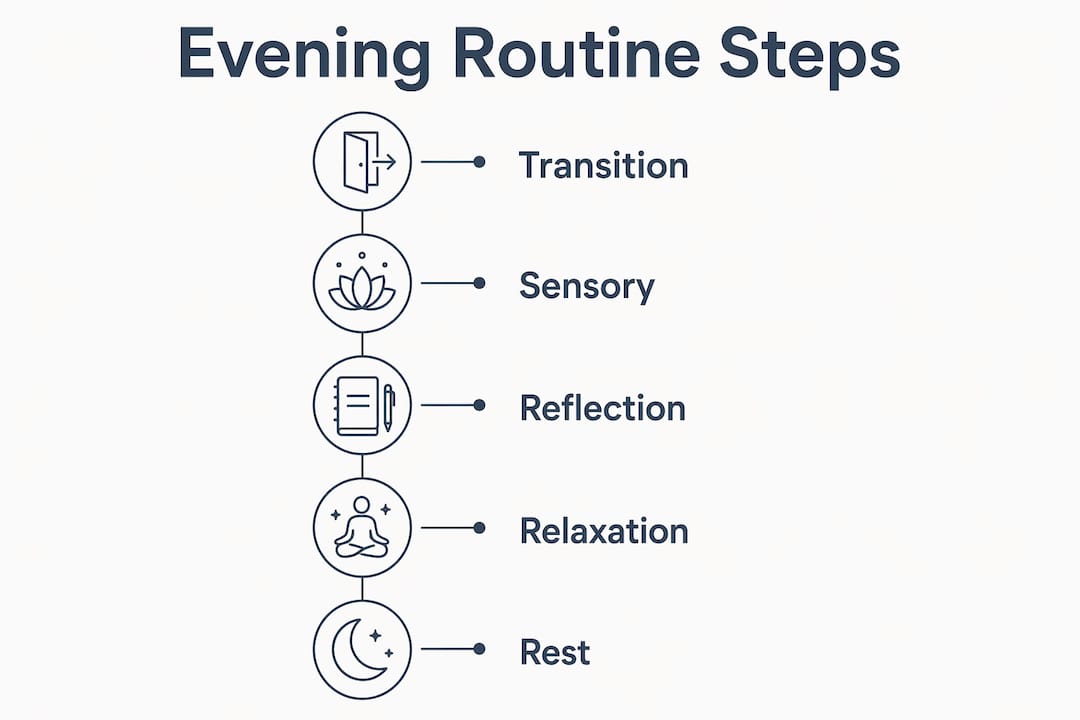
The most effective stress relief evening routine combines physical transition cues, sensory engagement, and mental release exercises into a single short block of time. Each element serves a specific purpose, and together they create a reliable signal that the workday is over.
Physical transition cues
Changing your clothes, moving to a different room, or dimming the lights are not trivial habits. They are physical signals that tell your nervous system to shift gears. Clear start and end markers create a “routine container” that supports a nervous system downshift. Shutting your laptop lid, for example, works as a concrete closing ritual that separates professional time from personal time.
Sensory engagement
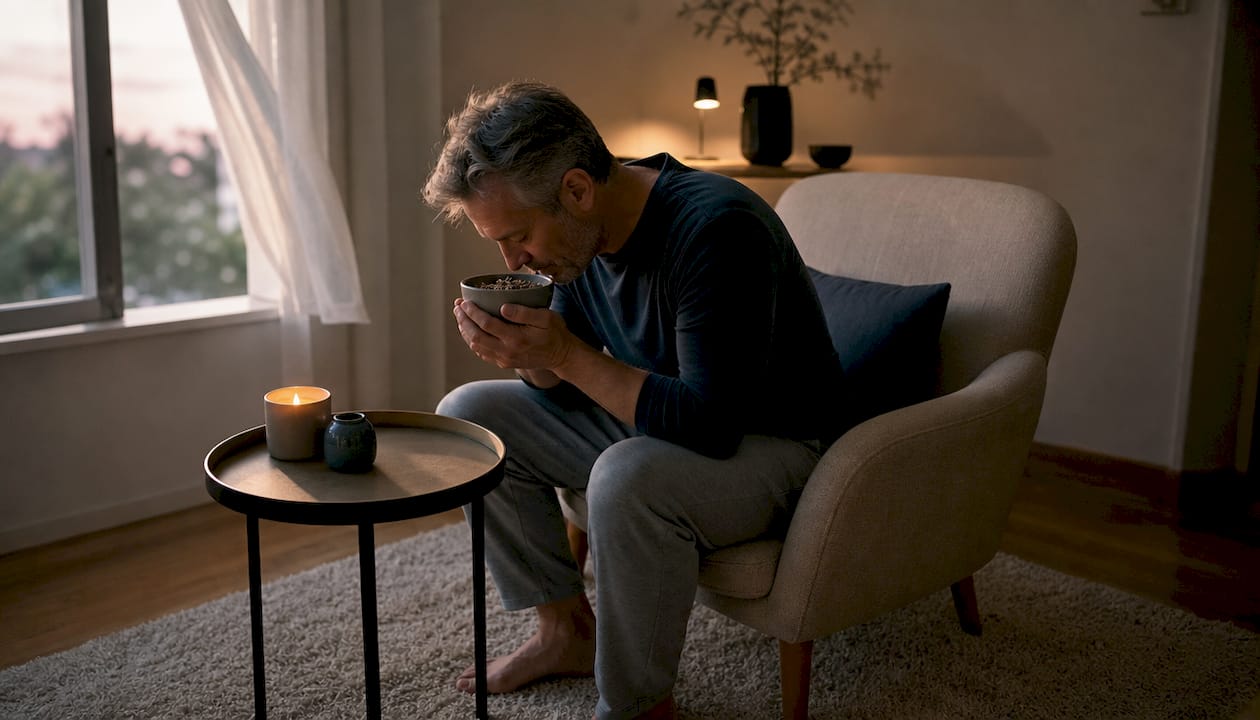
Calming scents, gentle sounds, and warm tactile experiences act as powerful nervous system regulators. Lavender and chamomile are the most studied options for promoting relaxation. Soft background music or nature sounds serve the same anchoring function. Using the same sensory cues each evening trains your brain to associate them with rest, making the transition faster over time.
Mental release exercises
Your brain holds onto unfinished tasks through a mechanism called the Zeigarnik effect. Externalizing tasks through a brain dump or a “tomorrow list” gives the brain permission to release those loops. Journaling for five minutes about what you accomplished, rather than what remains undone, reinforces a sense of closure. Both practices take under ten minutes and deliver measurable mental relief.
Relaxation techniques
The 4-7-8 breathing technique and progressive muscle relaxation are the two most evidence-backed tools for activating the parasympathetic nervous system. In 4-7-8 breathing, you inhale for 4 seconds, hold for 7 seconds, and exhale for 8 seconds. Progressive muscle relaxation involves tensing and releasing each muscle group from feet to shoulders. Both techniques reduce sleep onset time and lower heart rate within minutes.
-
Change clothes or location immediately after work
-
Dim lights or light a candle with a calming scent
-
To write a brain dump or tomorrow list (5 minutes)
-
Practice 4-7-8 breathing or progressive muscle relaxation (5 minutes)
-
Add gentle stretching or a short walk to release physical tension
-
Keep the total routine to 10–30 minutes
Pro Tip: Set a phone alarm labeled “Wind Down” at the same time each evening. The alarm acts as an external cue that removes the decision of when to start, which is the step most professionals skip.
How do brief evening routines scientifically improve stress and sleep quality?
Short, consistent routines outperform occasional long self-care sessions by a wide margin. 56 controlled trials show that daily mindfulness and self-care practices of 5–10 minutes produce measurable reductions in stress and burnout. That finding flips the common assumption that self-care requires significant time investment.
The mechanism is physiological. The parasympathetic nervous system, often called the “rest and digest” system, counteracts the stress response triggered by the sympathetic nervous system. Controlled breathing and muscle relaxation activate the parasympathetic branch directly, lowering cortisol and slowing heart rate. The effect is not subtle. Most professionals notice a physical shift within the first few minutes of a consistent practice.
“Intentional rituals cultivate self-kindness, nervous system calm, and emotional literacy. High-functioning professionals who practice evening rituals consistently report stronger emotional regulation and a clearer sense of restorative presence at the end of each day.” — Integrative Psychotherapy New York
The Zeigarnik effect adds another layer of complexity. The brain is wired to fixate on incomplete tasks, which is why work thoughts intrude during dinner or right before sleep. Externalizing those tasks onto paper deactivates that fixation. The brain registers the written list as a completed action and stops cycling through the unfinished items.
| Technique | Primary benefit | Time required |
|---|---|---|
| 4-7-8 breathing | Activates parasympathetic nervous system | 5 minutes |
| Progressive muscle relaxation | Reduces physical tension and sleep onset time | 10 minutes |
| Brain dump / tomorrow list | Clears Zeigarnik effect mental loops | 5 minutes |
| Sensory ritual (scent, sound) | Anchors nervous system to relaxation cues | 2–3 minutes |
| Gentle stretching | Releases physical tension from sedentary work | 5–10 minutes |
Micro-transitions work precisely because they are repeatable. A 45-minute yoga session on Saturday does not train your nervous system to relax on Tuesday evening. A five-minute breathing practice performed every night does.
How can busy professionals integrate evening self-care without extending their day?
Effective self-care for busy professionals is not about adding time. It is about converting existing daily micro-transitions into stress-relieving rituals. That reframe removes the most common objection: “I don’t have time.”
The most practical entry point is an existing cue. The end of your commute, the moment you send your last email, or the first sip of an evening drink can all serve as triggers for your routine. Attaching a new habit to an existing behavior, a technique called “habit stacking,” dramatically increases follow-through without requiring extra willpower.
-
Identify your natural transition moment. This is the moment your workday functionally ends, whether that is closing your laptop, leaving the office, or finishing your commute.
-
Choose one or two rituals to start. A brain dump plus 4-7-8 breathing covers both mental and physical decompression in under ten minutes.
-
Schedule it as a calendar event. Treat your wind-down block the same way you treat a meeting. Block 15–20 minutes and protect it.
-
Set a sensory cue. Light the same candle or play the same playlist each evening. The sensory signal accelerates the transition over time.
-
Add rituals gradually. Start with two practices for two weeks before adding a third. Gradual building prevents the routine from feeling like another obligation.
Setting boundaries around after-hours work communication sustains professional capacity without reducing productivity. Explicitly stating your availability hours to colleagues and turning off work notifications after a set time protects the mental space your routine requires. Boundaries are not a luxury. They are the structural support that makes any evening routine sustainable.
Pro Tip: If you work from home, create a physical “commute substitute.” A ten-minute walk around the block before your routine begins gives your brain the spatial separation it needs to register that work is over.
What common mistakes undermine evening self-care routines?
The most damaging mistake is building an overly elaborate routine. Overly complex routines add pressure rather than relief, which defeats the purpose entirely. A routine that requires 90 minutes of preparation will be skipped on the hardest days, which are exactly the days it is needed most.
-
Skipping the brain dump. Failing to externalize work tasks leaves the Zeigarnik effect active, causing mental intrusion throughout the evening and into sleep.
-
Ignoring sensory cues. Jumping straight to a screen after work bypasses the nervous system’s need for a sensory signal that the day has ended.
-
No clear start or end point. A routine without defined boundaries blurs into the rest of the evening and loses its decompression function.
-
Allowing after-hours work communication. Checking email at 9:00 PM reactivates the stress response and undoes any relaxation achieved earlier.
-
Binge self-care on weekends. Sporadic long sessions do not compensate for skipped daily routines. Consistency is the active ingredient.
-
Ignoring energy level variation. A high-adrenaline shift or a difficult client call may require a longer or more physical decompression practice. Rigid routines that ignore context become unsustainable.
The fix for most of these mistakes is the same: simplify and anchor. Two consistent rituals performed every night produce more benefit than seven rituals performed twice a week.
Key takeaways
A brief, consistent evening routine performed immediately after work is the most effective way for busy professionals to lower cortisol, detach mentally from work, and improve sleep quality.
| Point | Details |
|---|---|
| Optimal routine length | Keep your routine to 10–30 minutes performed right after work ends. |
| Mental release is non-negotiable | Write a brain dump or tomorrow list every evening to clear Zeigarnik effect loops. |
| Sensory cues accelerate relaxation | Use the same scent or sound each night to train your nervous system to shift faster. |
| Consistency beats duration | Five minutes every night outperforms 60 minutes once a week for stress reduction. |
| Boundaries protect the routine | Turn off work notifications before your wind-down block to prevent stress reactivation. |
What Wellthious has learned about evening routines that most advice misses
The most common piece of advice about self-care is to “make time for yourself.” That framing is well-intentioned and almost entirely unhelpful for professionals who are already running at capacity. The real shift is not about finding time. It is about recognizing that the transition moments you already have are enough.
What Wellthious has observed, working with people who prioritize wellness in demanding careers, is that the professionals who sustain their routines long-term are not the ones with the most elaborate practices. They are the ones who treat their two or three rituals as non-negotiable, the same way they treat brushing their teeth. The ritual does not need to be impressive. It needs to be consistent.
The other thing worth saying directly: self-compassion is not a soft add-on to a wellness routine. It is the mechanism that keeps the routine alive. On the nights when you skip it, the response that determines whether you come back tomorrow is not discipline. It is kindness toward yourself. Rigid perfectionism around self-care is still perfectionism, and it produces the same burnout it is meant to prevent.
Start with one ritual tonight. Not five. One. Build from there.
— Wellthious
Wellthious products that support your evening wind-down
While breathing exercises and journaling help calm the mind, many people also carry stress physically—in their neck, shoulders, scalp, and upper back after hours of sitting at a desk or working on a computer.
Gentle massage can complement your evening routine by helping release built-up muscle tension before bed. When your body begins to relax, it often becomes easier for your mind to follow.
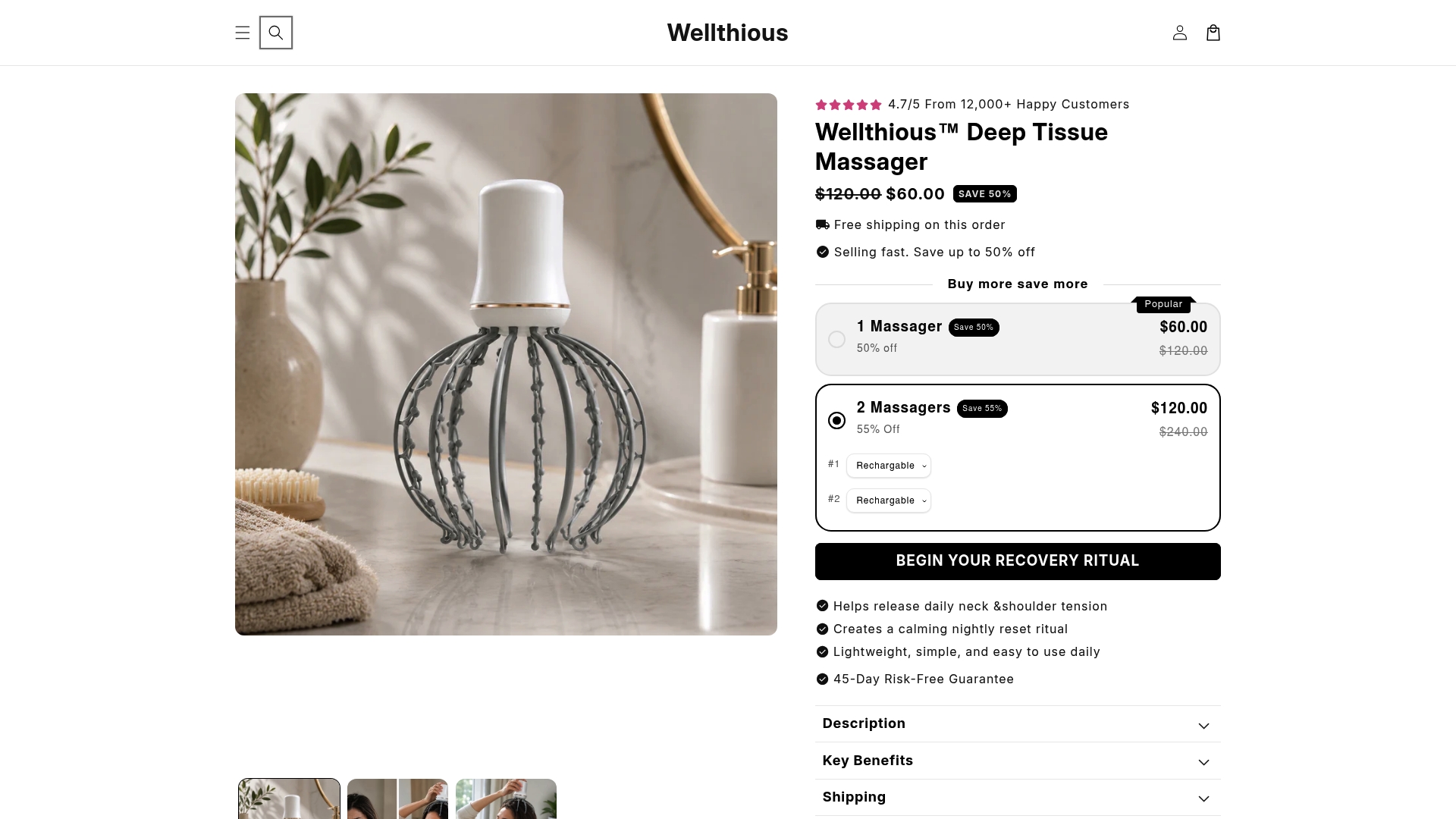
That’s why the Wellthious Stress Relief Massager was designed to fit naturally into a 10–30 minute evening wind-down routine. Whether you use it after work, while reading, or before bed, it can become part of a consistent ritual that helps you transition from work mode into a more relaxed state.
The Wellthious Stress Relief Massager targets muscle tension in the areas most affected by desk work and screen time, supporting the relaxation response that breathing exercises and journaling begin. Used consistently as part of your evening routine, it adds a physical dimension to decompression that complements mental relaxation techniques.
Explore the Wellthious collection to discover wellness products designed to support everyday relaxation and self-care.
The most effective self-care routines aren’t the longest—they’re the ones you can maintain consistently. At Wellthious, we believe effective self-care doesn’t have to be complicated. A few intentional minutes each day can have a meaningful impact on how you feel.
FAQ
How long should an evening self-care routine be?
An effective routine lasts 10–30 minutes, performed immediately after work ends. Research shows that even 5–10 minute consistent practices produce measurable stress and burnout reductions.
What is the best breathing technique for evening stress relief?
The 4-7-8 technique is the most evidence-backed option. Inhale for 4 seconds, hold for 7 seconds, and exhale for 8 seconds to activate the parasympathetic nervous system and reduce sleep onset time.
Why do work thoughts keep intruding during the evening?
The Zeigarnik effect causes the brain to fixate on incomplete tasks. Writing a brain dump or tomorrow list externalizes those tasks and gives the brain permission to stop cycling through them.
How can I start a routine when I have no extra time?
Attach your routine to an existing transition moment, such as the end of your commute or the moment you close your laptop. Converting an existing micro-transition into a ritual adds no time to your day.
Does setting work boundaries actually improve performance?
Setting clear boundaries around after-hours communication sustains professional capacity without reducing productivity. Protecting personal time improves resilience and long-term performance, not just well-being.