
A relaxing evening routine is a consistent set of calming activities you perform before bed to signal your body that the day is over, reduce stress, and prepare your mind for restorative sleep. Sleep researchers call this process “sleep hygiene,” and the evening wind-down is its most critical phase. The right routine does not require hours or an elaborate checklist. It requires the right cues, repeated consistently. This guide covers the core components of an effective calming routine, specific relaxation techniques backed by research, and how to build a version that fits your actual life.
How to create a relaxing evening routine: the core components
The foundation of any effective evening wind-down is timing. Start winding down 60 minutes before your target bedtime. That window gives your cortisol levels time to drop and your melatonin levels time to rise, which are the two hormonal shifts your body needs to move from alert to sleepy.
1. Cut screens an hour before bed
Smartphone and tablet screens emit blue light that suppresses melatonin production. Avoiding smartphone use during the last 60 minutes before sleep prevents the kind of sleep disturbances most people blame on stress alone. Swap the phone for a physical book, a notebook, or a conversation.
2. Switch your lighting
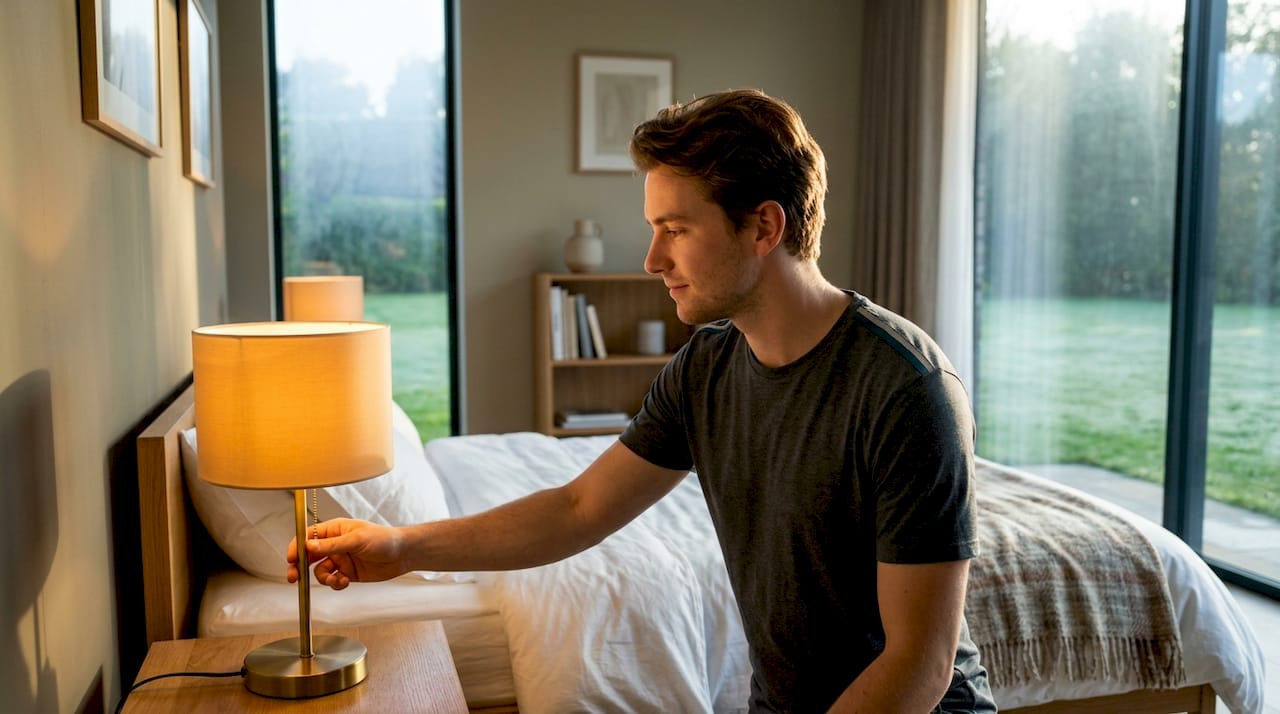
Overhead lighting keeps your brain in daytime mode. Switching to warm, amber lighting 45 minutes before bed cues the suprachiasmatic nucleus, the brain’s internal clock, to release melatonin. Use a lamp with a warm bulb or a dimmer switch. This single change produces a measurable shift in how quickly you feel sleepy.
3. Add a soothing drink ritual
Chamomile tea is not just a comfort habit. A 2019 meta-analysis in Phytotherapy Research confirms that chamomile consumption significantly improves sleep quality compared to a placebo. Brewing a cup of chamomile or another caffeine-free herbal tea gives your routine a sensory anchor, something your body begins to associate with winding down.
4. Prepare your sleep environment
Your bedroom should be cool, dark, and quiet before you get into bed. Set out anything you need for the morning so your brain does not rehearse tomorrow’s tasks while you are trying to sleep. A tidy, prepared space reduces the low-level mental noise that keeps many people awake.
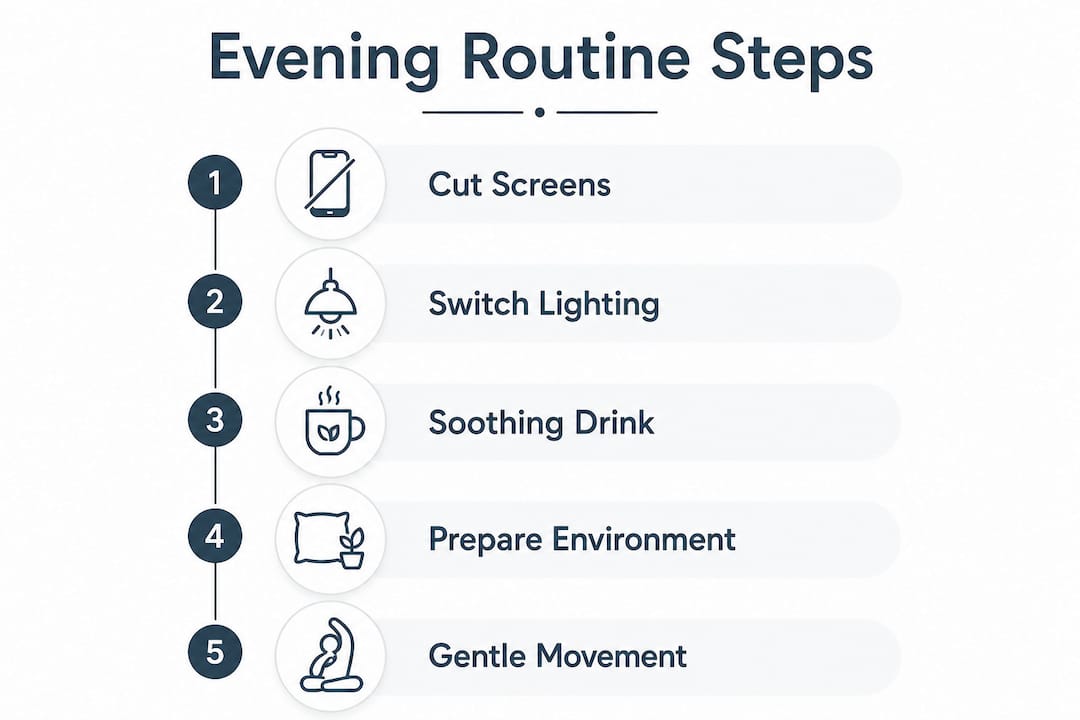
5. Add gentle movement or stretching
Light stretching or a short yoga sequence releases physical tension stored from the day. Keep it gentle. Intense exercise within two hours of bedtime raises your core temperature and heart rate, which delays sleep onset rather than helping it.
Pro Tip: Build your routine around three non-negotiable cues: dim the lights, make your tea, and open your journal. Those three actions alone signal your nervous system to begin calming down, even on nights when you skip everything else.
The environment and activity type both shape how well you relax. Lower stimulation and soothing surroundings ease the transition to sleep more reliably than any single technique on its own.
What relaxation techniques actually work at night?
Specific techniques activate the parasympathetic nervous system, the part of your nervous system responsible for rest and digestion. These are not vague suggestions. They are exercises with measurable physiological effects.
-
Diaphragmatic breathing: Breathe in slowly through your nose for four counts, hold for two, and exhale through your mouth for six. The Sleep Foundation recommends as few as 10 deep, slow breaths to engage the body’s natural relaxation response. Ten breaths takes under two minutes and works immediately.
-
Progressive muscle relaxation (PMR): PMR systematically tenses and relaxes muscle groups from your feet upward. You tense each group for five seconds, then release. The contrast between tension and release teaches your body what physical calm actually feels like, which is useful if you carry stress in your shoulders, jaw, or back.
-
Journaling and brain dumping: Writing down your worries, your to-do list for tomorrow, or a few sentences about your day helps offload mental clutter and reduces the rumination that interferes with sleep. Therapists use journaling as a clinical tool to externalize worry. You do not need to write well. You just need to write.
-
Light reading: Fiction works better than nonfiction for winding down because it pulls your attention into a different world rather than feeding your problem-solving mode. Read physical books when possible to avoid screen exposure.
-
Visualization and NSDR: Non-sleep deep rest (NSDR) is a protocol developed from yoga nidra research. You lie still, close your eyes, and guide your attention through your body or a calm mental scene. It does not require sleep to produce recovery benefits.
Pro Tip: If you only have five minutes, choose diaphragmatic breathing. It is the fastest technique to activate calm and requires no equipment, no space, and no preparation. Pair it with your daily relaxation practice for compounding results.
How do you personalize an evening routine to fit your lifestyle?
The most common reason evening routines fail is that they are built for an ideal version of your day, not your actual one. A rigid, clock-based checklist collapses the first time work runs late, a friend calls, or you are simply exhausted. Flexible, cue-based routines adapt better to life changes than fixed schedules do.
Here is a practical framework for building a routine that sticks:
-
Choose a trigger, not a time. Instead of “start at 9:00 PM,” use “start when I finish cleaning up after dinner.” A trigger is portable. A clock time is fragile.
-
Build a minimum version. Identify the two or three activities that matter most to you, such as dimming the lights, doing ten breaths, and writing three sentences in a journal. That is your floor. On hard days, you do the minimum. On good days, you expand it.
-
Anchor new habits to existing ones. If you already brush your teeth at the same time each night, attach your breathing exercise to that moment. Habit stacking uses existing neural pathways to make new behaviors automatic faster.
-
Adapt for stress seasons. During high-pressure periods at work or during life transitions, strong mental shutdown becomes more important, not less. Shorten the routine if needed, but do not eliminate it. Even five minutes of intentional wind-down outperforms none.
-
Review your routine monthly. What worked in one season of life may not fit the next. Spend five minutes at the start of each month asking whether your current routine still matches your schedule and energy levels. Adjust without guilt.
Small habits performed consistently outperform longer, ambitious routines that collapse quickly. A two-minute routine you do every night beats a 45-minute routine you do twice a week.
What mistakes undermine a calming evening routine?
Most people do not fail at evening routines because they lack discipline. They fail because the routine is designed in a way that works against them.
-
Overstimulation before bed: Action movies, heated conversations, and social media scrolling all raise cortisol and delay sleep onset. The content matters as much as the screen itself. Even without a screen, an argument or a stressful phone call can reset your nervous system back to alert mode.
-
Making the routine too long: A 12-step evening ritual sounds appealing in theory. In practice, it creates a new source of stress when you cannot complete it. Keep your core routine under 30 minutes. Add optional steps only when time allows.
-
Skipping it on irregular days: Travel, late events, and social obligations disrupt routines. The solution is not to skip entirely but to run your minimum version. Two deep breaths and a moment of stillness count. Consistency matters more than completeness.
-
Ignoring mental resistance: Boredom with a routine is a signal to refresh it, not abandon it. Swap one element every few weeks. Change the tea, try a different breathing pattern, or add a new book.
Pro Tip: Set a phone alarm labeled “wind down” for 60 minutes before your target bedtime. The alarm is not a command. It is a reminder that you have permission to stop. Most people find that the hardest part of an evening routine is giving themselves permission to begin it.
Use environmental triggers to reduce the friction of starting. Lay out your journal the night before. Keep your herbal tea on the counter. Put your phone charger outside the bedroom. These physical cues make the right behavior the path of least resistance. For more on unwinding after stressful days, the approach is the same: reduce friction, repeat the cue, and trust the process.
Key Takeaways
A consistent, cue-based evening routine is the most reliable method for improving sleep quality and reducing nightly stress.
| Point | Details |
|---|---|
| Start 60 minutes early | Begin winding down an hour before bed to lower cortisol and raise melatonin naturally. |
| Use lighting as a cue | Switch to warm amber light 45 minutes before bed to trigger melatonin production. |
| Breathe first | Ten slow diaphragmatic breaths activate the parasympathetic nervous system in under two minutes. |
| Build a minimum version | Identify your two or three core habits so you can maintain the routine on difficult nights. |
| Cues beat clocks | Anchor your routine to a trigger, not a fixed time, for better long-term consistency. |
What I have learned from building evening routines that actually last
The most common mistake I see is treating an evening routine like a productivity system. People build elaborate sequences, track completion rates, and feel like failures when life interrupts. That mindset is the problem.
A calming evening routine is not a performance. It is a signal. Your body does not need 45 minutes of perfectly executed steps. It needs a few repeated cues that say “the day is done.” The moment you internalize that, the routine becomes easier to maintain and easier to recover after you miss a night.
The other thing worth saying plainly: the environment does more work than most people expect. Dimming the lights and putting the phone in another room changes the physical conditions of your space. Your nervous system responds to those conditions before you even start a breathing exercise. Start with the environment, then add the techniques.
Personalization is not optional. A routine built around someone else’s schedule, preferences, or stress patterns will not hold. The evening self-care routine that works for a busy professional looks different from the one that works for a parent of young children or someone managing chronic stress. Build yours around your actual life, not an aspirational one.
Start with two habits. Do them for two weeks. Then add one more.
— Wellthious
Wellthious products that support your evening wind-down
Physical tension is one of the most overlooked barriers to a good night’s sleep. You can do all the right mental work and still lie awake because your shoulders, neck, or lower back are holding the day’s stress.

The Wellthious Stress Relief Massager is designed to address exactly that. Use it for 10 to 15 minutes during your wind-down window to release muscle tension before bed. For deeper tissue recovery, the Wellthious Deep Tissue Massager works through layers of muscle that light stretching cannot reach. Both products integrate directly into the routine structure covered here. Explore the full Wellthious wellness collection to find the tools that fit your self-care routine.
FAQ
How long should an evening routine be?
A calming evening routine works best when it runs 30 to 60 minutes. The minimum effective version can be as short as 10 minutes if it includes consistent cues like dimming lights and slow breathing.
What is the best time to start a bedtime routine?
Start your wind-down 60 minutes before your target sleep time. That window allows cortisol to drop and melatonin to rise, which are the two hormonal shifts needed for restful sleep.
Does journaling before bed actually help with sleep?
Yes. Journaling externalizes mental clutter and reduces rumination, both of which are common causes of delayed sleep onset. Even three to five sentences written before bed produce a measurable calming effect.
Can I do an evening routine if my schedule changes every night?
Yes. Build a cue-based routine instead of a clock-based one. Anchor your wind-down to a trigger like finishing dinner or changing out of work clothes, so it adapts to irregular schedules automatically.
What is the single most effective evening relaxation technique?
Diaphragmatic breathing is the fastest and most accessible technique. Ten slow, deep breaths activate the parasympathetic nervous system in under two minutes and require no equipment or preparation.