
Stress-induced hair loss is a biologically real and measurable condition, not a myth. Your body responds to stress through hormonal and inflammatory pathways that directly disrupt the hair growth cycle. Clinical research confirms that psychological stress ranks as the probable cause in about 30% of diffuse hair loss cases, making it the second most common trigger behind fever. The medical term for this condition is telogen effluvium, and understanding how it works is the first step toward doing something about it.
Can stress cause hair loss? Here’s what the science says
Stress disrupts hair growth through two main pathways: hormonal interference and inflammatory signaling. Both are well-documented in clinical research, and both produce measurable changes at the follicle level.
The hormone cortisol sits at the center of the stress-hair connection. Elevated cortisol blocks dermal papilla cells from releasing a protein called GAS6, which is responsible for waking dormant hair follicle stem cells. Without GAS6, follicles stay locked in their resting phase and new hair growth stalls. This is not a minor disruption. It is a direct biochemical block on the hair cycle.

The second pathway involves inflammation. Chronic stress triggers signaling molecules that increase inflammation and oxidative stress around hair follicles, forcing them to exit the active growth phase prematurely. Think of it like a fire alarm going off in a building. Everything stops, and everyone evacuates, whether or not there is an actual fire.
A third, less-discussed mechanism involves neurotrophic factors. Popular belief that cortisol alone drives shedding oversimplifies the picture. Stress also depletes follicle neurotrophic factors such as NGF, BDNF, and GDNF, which are proteins that support follicle survival and growth. Lower levels of these proteins accelerate hair loss, particularly in people with a genetic predisposition.
Pro Tip: If you notice increased shedding, track the date and look back 2–3 months for a significant stressor. That timing gap is the biological fingerprint of telogen effluvium.
- Cortisol elevation blocks GAS6 release, keeping follicles dormant
- Inflammatory signaling forces follicles out of the active growth phase early
- Neurotrophic factor depletion (NGF, BDNF, GDNF) weakens follicle survival
- Neuropeptide release (substance P) promotes scalp inflammation and immune activation
What types of hair loss does stress trigger?
Not all stress-related hair loss looks the same. Three distinct conditions are linked to stress, and each has a different appearance, cause, and outlook.
| Condition | Pattern | Stress role | Reversible? |
|---|---|---|---|
| Telogen effluvium | Diffuse thinning across scalp | Direct trigger via cortisol and inflammation | Yes, typically within 3–6 months |
| Alopecia areata | Patchy, coin-sized bald spots | Stress activates autoimmune attack on follicles | Often, but unpredictable |
| Androgenetic alopecia | Receding hairline or crown thinning | Stress accelerates genetic predisposition | Partial, with treatment |
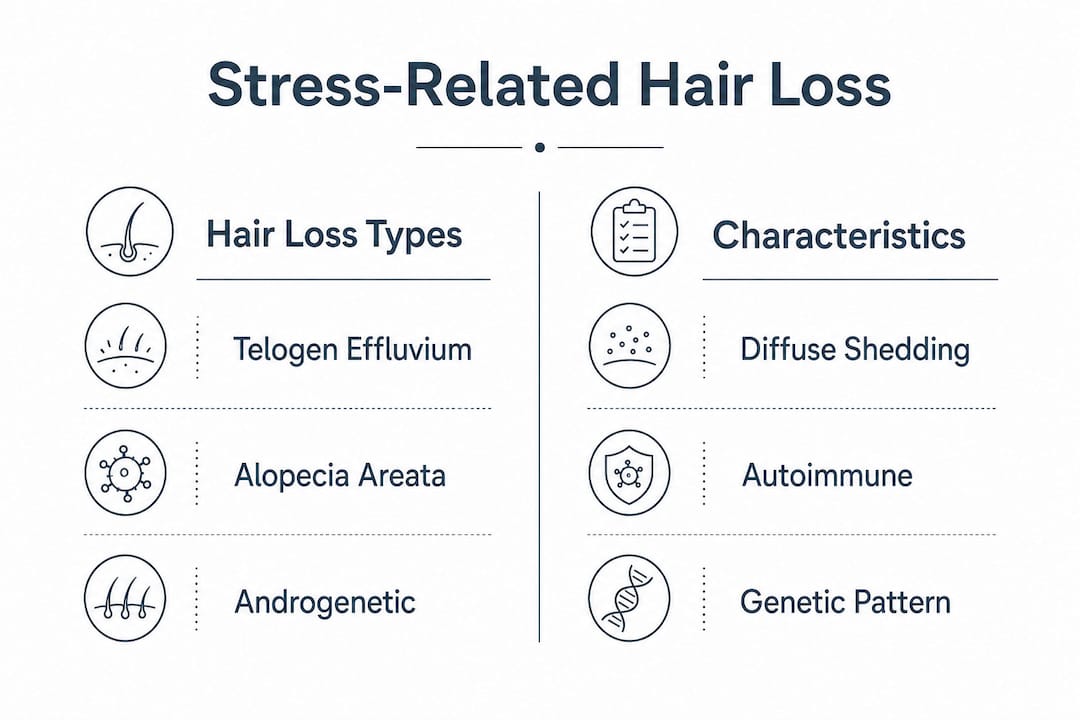
Telogen effluvium is the most common stress-related condition. It produces diffuse shedding across the entire scalp rather than concentrated patches. The follicles are not destroyed. They simply go dormant, which means full recovery is the expected outcome once the stressor is resolved.
Alopecia areata is an autoimmune condition. Stress triggers the release of neuropeptides like substance P, which promote scalp inflammation and can initiate an immune attack on hair follicles. The result is patchy hair loss that appears suddenly. Recovery is possible but less predictable than with telogen effluvium.
Androgenetic alopecia, commonly called pattern hair loss, is driven by genetics. Stress does not cause it directly. However, chronic stress depletes the neurotrophic factors that normally slow its progression, meaning prolonged stress can unmask or speed up genetic hair loss in people who were already predisposed. If your shedding follows a patterned distribution rather than diffuse thinning, a dermatologist visit is worth prioritizing.
How long does stress-related shedding last?
The timeline of stress-induced hair loss surprises most people. Shedding does not begin immediately after a stressful event. There is a 2–3 month lag between the stressor and visible hair fall, caused by the duration of the telogen (resting) phase. Follicles pushed into dormancy by stress complete their resting cycle before releasing the hair shaft.
This delay creates a frustrating situation. You may feel that your stress has passed, only to notice heavy shedding weeks later. That shedding is the biological echo of a stressor that already ended.
The numbers make the scale of shedding clear. People with stress-related telogen effluvium shed 150–300 hairs daily, compared to the normal rate of 50–100 hairs per day. That is up to six times the typical daily loss. Noticing clumps in the shower or on your pillow is a reliable signal that something disrupted your hair cycle 2–3 months earlier.
Recovery follows a predictable path once the stressor is removed. Telogen effluvium resolves with regrowth in 3–6 months in most cases. The follicles were never damaged. They were dormant. Once the hormonal and inflammatory environment normalizes, follicles return to active growth and new hair emerges. Prolonged shedding beyond six months usually signals an ongoing stressor, a nutritional deficiency, or an underlying condition that needs medical evaluation.
How to manage and reduce stress-induced hair loss
Managing stress-induced hair loss requires addressing both the root cause (stress itself) and the biological environment that supports hair regrowth. Neither alone is sufficient.
-
Address the stress source directly. Cognitive behavioral therapy (CBT) is the most evidence-backed approach for chronic stress. Mindfulness-based stress reduction (MBSR) programs show measurable reductions in cortisol levels. Even 20 minutes of daily moderate exercise lowers cortisol and improves sleep quality, both of which benefit follicle health.
-
Prioritize sleep hygiene. Cortisol follows a circadian rhythm. Poor sleep keeps cortisol elevated overnight, extending the hormonal disruption to your follicles. Aim for 7–9 hours of consistent sleep and limit screen exposure in the hour before bed.
-
Support follicle nutrition. Key micronutrients for hair health include iron, zinc, biotin, vitamin D, and omega-3 fatty acids. Deficiencies in any of these compounds can extend shedding even after stress resolves. A blood panel from your doctor can identify gaps quickly.
-
Consider topical minoxidil. For people whose shedding persists beyond six months, minoxidil applied to the scalp can stimulate follicle reactivation. It does not address the stress cause but can support regrowth during recovery. Consult a dermatologist before starting.
-
Add scalp massage to your routine. Regular scalp massage improves blood circulation to follicles and reduces localized tension. Pairing it with stress reduction techniques creates a compounding benefit. Resources on scalp massage for stress relief can help you build a consistent practice.
Pro Tip: Reducing stress naturally at home, through breathing exercises, warm baths, or gentle massage, can lower cortisol without medication. Wellthious has a practical guide on natural stress reduction methods worth bookmarking.
Key Takeaways
Stress causes hair loss through documented biological mechanisms, and recovery is expected once the stressor is removed and follicle health is supported.
| Point | Details |
|---|---|
| Stress is a proven trigger | Psychological stress causes about 30% of diffuse hair loss cases, ranking second only to fever. |
| Cortisol blocks regrowth | Elevated cortisol suppresses GAS6 release, keeping follicles locked in the resting phase. |
| Shedding peaks after stress eases | A 2–3 month lag means hair falls out after the stressor has already passed, not during it. |
| Recovery takes 3–6 months | Telogen effluvium is reversible; follicles are dormant, not destroyed, and regrow after stress resolves. |
| Stress can accelerate genetic loss | Chronic stress depletes neurotrophic factors, speeding up androgenetic alopecia in predisposed individuals. |
What I’ve learned about stress and hair loss that most articles miss
The most damaging misconception I see is the belief that hair loss and stress happen at the same time. People manage a difficult period, feel better, and then panic two months later when the shedding starts. They assume something new is wrong. What they are actually seeing is the delayed biological response to a stressor that already ended. Understanding that timing removes a significant amount of unnecessary fear.
The second thing worth saying plainly: hair loss itself becomes a stressor. The anxiety of watching your hair thin can sustain the very cortisol elevation that prolongs shedding. This bidirectional loop is real, and it is one reason why psychological support matters as much as nutritional or topical treatment. Treating only the scalp while ignoring the mental load is an incomplete approach.
Patience is not passive. During the 3–6 month recovery window, consistent sleep, good nutrition, and daily stress management are active interventions. They create the biological conditions that allow follicles to reactivate. If shedding continues past six months or follows a patterned distribution, that is the signal to see a dermatologist. Not because recovery is impossible, but because a second condition may need its own treatment plan.
— Wellthious
How Wellthious supports your stress relief routine
Reducing daily stress is the most direct way to protect your hair and your overall well-being. Wellthious designs products specifically to make that easier.

The Wellthious™ Deep Tissue Massager targets muscle tension and promotes relaxation, giving your nervous system a consistent signal to downregulate. Used regularly, it supports the kind of sustained stress reduction that lowers cortisol over time. Pair it with the stress management techniques covered here for a complete approach. Browse the full Wellthious wellness collection to find products that fit your daily routine and support your recovery from the inside out.
FAQ
Does stress cause permanent hair loss?
Stress-induced telogen effluvium is not permanent. Follicles enter dormancy but are not damaged, and hair regrowth typically occurs within 3–6 months after the stressor is removed.
How much hair loss from stress is normal?
People with stress-related telogen effluvium shed 150–300 hairs daily, compared to the normal rate of 50–100 hairs per day. Shedding above 150 hairs daily for several weeks warrants attention.
Can anxiety cause hair loss the same way stress does?
Yes. Anxiety produces the same cortisol elevation and inflammatory signaling as acute stress, making it a recognized trigger for telogen effluvium and a potential contributor to alopecia areata episodes.
Why is my hair still falling out after my stress ended?
The 2–3 month lag between a stressor and visible shedding means hair loss often peaks after the stressful period has passed. This is normal and does not indicate a new problem.
When should I see a doctor about stress-related hair loss?
See a dermatologist if shedding continues beyond six months, follows a patterned distribution (receding hairline or crown thinning), or is accompanied by other symptoms like fatigue or scalp irritation.